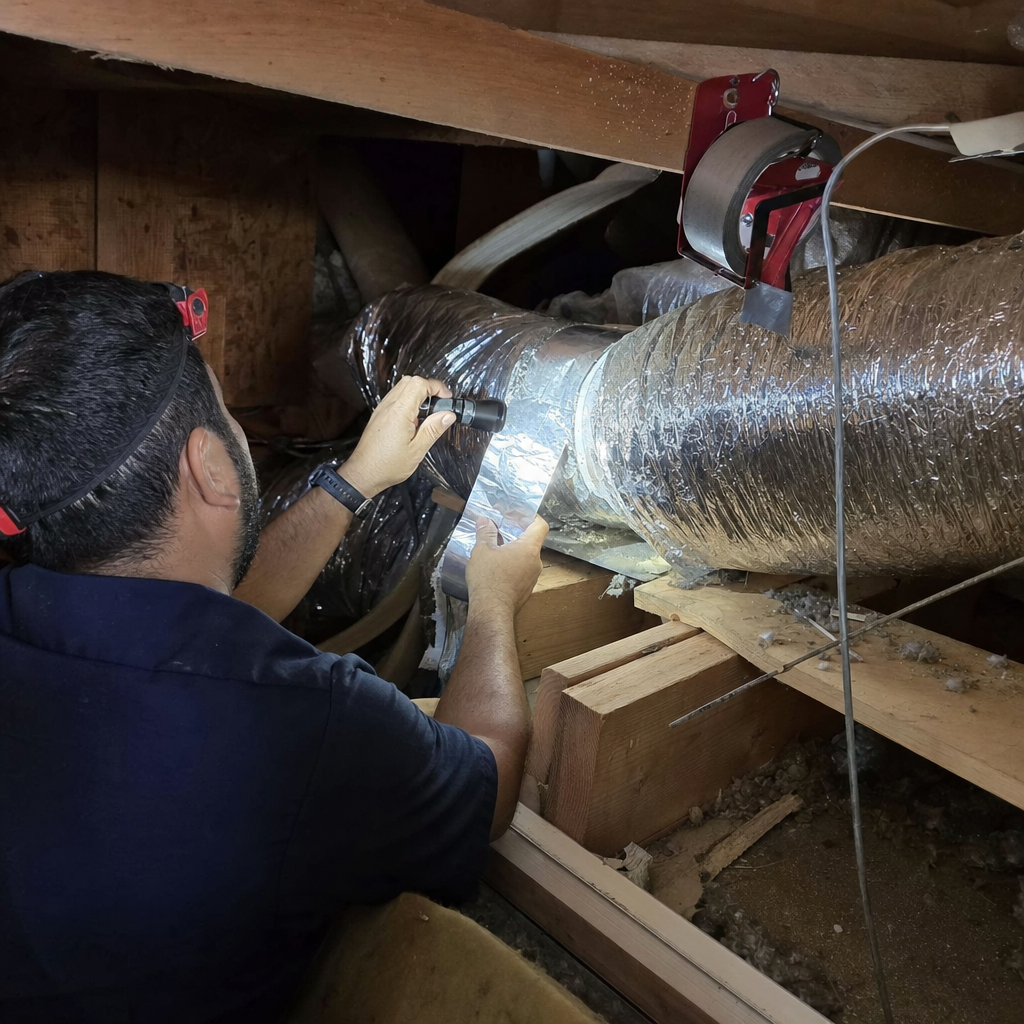
Duct Repair & Sealing in Canoga Park, CA
Duct repair and sealing in Canoga Park typically runs $350–$1,200 depending on system age, duct type, and the extent of seal failure — and most jobs are completed in a single visit. Canoga Park’s 1950s–1960s housing stock, combined with wildfire smoke infiltration through the Santa Susana Pass corridor, creates duct failure patterns that are genuinely different from the rest of LA. Our Duct Repair & Sealing team knows exactly what to look for in these homes — call us at (424) 365-8367 for a free, no-obligation estimate.
Why Premier Air Duct Solutions Woodland Hills Is Canoga Park’s Preferred Duct Repair & Sealing Company
Scott Hill doesn’t dispatch a crew and follow up by phone — he shows up to every job himself, running the diagnostic and doing the work. That matters in Canoga Park, where the combination of aging sheet-metal ductwork and wildfire particulate infiltration means a technician needs to actually understand what they’re looking at, not just run a checklist. Scott has personally worked jobs throughout the 91303 and 91304 ZIP codes, on homes near Victory Boulevard, along Reseda Boulevard, and in the hillside-adjacent tracts near Santa Susana Pass Road. You’re not getting a rotating subcontractor crew — you’re getting the owner of the business with his hands in your ductwork.
Premier Air Duct Solutions has earned 829 five-star reviews, one of the highest verified review volumes in the air duct category across the western San Fernando Valley. That rating didn’t come from a handful of easy jobs — it reflects consistent, accountable work across a high volume of homes that include exactly the kind of complex, aging systems common in Canoga Park. Customers specifically note that Scott explains what he finds, shows the evidence, and doesn’t recommend work that isn’t needed. That’s the standard we hold every Canoga Park visit to.
The Woolsey Fire Problem That’s Still Inside Canoga Park Ductwork
This is the local context that shapes nearly every duct repair job we take in this part of the Valley, and it’s worth explaining directly.
The Santa Susana Pass corridor acts as a natural chimney between the Simi Valley hills and the western Valley floor. During the November 2018 Woolsey Fire — which burned through adjacent West Hills and Bell Canyon while thousands of HVAC systems in Canoga Park were running their heating cycles — dense combustion smoke and fine ash were pulled directly into air intake zones throughout the neighborhood. Homes in the 91303 and 91304 ZIP codes, particularly those in the Devonshire Highlands and hillside-adjacent tracts near Santa Susana Pass Road, drew that particulate deep into their ductwork during active fire conditions.
Here’s why that matters for duct repair specifically: wildfire ash and combustion particulate don’t behave like ordinary household dust. They’re chemically abrasive. In Canoga Park’s aging sheet-metal systems — many with original 1950s and 1960s mastic seals already made brittle by decades of 100–110°F summer cycling — that ash accelerates joint separation and seal cracking every single cooling season that follows. The particulate packs into collar joint gaps, acts as a grinding medium against the metal during thermal expansion, and causes seals to fail in ways that compound with each passing year. Homes whose systems ran during or immediately after the Woolsey Fire are, in many cases, operating with structurally compromised duct joints that standard cleaning alone won’t fix.
We responded to a home in the Bell Canyon-adjacent tract near Santa Susana Pass Road where the homeowner had noticed a persistent smoky odor returning each summer when the AC kicked on. Our techs found brittle, cracked mastic seals at nearly every collar joint on the original sheet-metal trunk line, with grey-black ash residue packed into the gaps — a direct signature of Woolsey Fire infiltration still off-gassing years later. We applied fresh mastic sealant across all failed joints, replaced a collapsed flex duct branch feeding the back bedrooms, and wrapped exposed duct runs with new insulation. Measured air loss at the registers dropped by more than half.
If your Canoga Park home was running its HVAC during or after that fire and you haven’t had the ductwork inspected since, that’s not a routine maintenance situation. It’s a specific structural failure pattern that needs mastic resealing and, in many cases, flex duct replacement.
Our Duct Repair & Sealing Services in Canoga Park
Mastic Sealant Application
Mastic is the right material for Canoga Park’s aging sheet-metal systems — it stays flexible through extreme thermal cycling in a way that duct tape never will. Original mastic seals on 1950s–1960s trunk lines in the 91303 and 91304 ZIP codes typically turn chalk-brittle after decades of 100°F+ summers, then crack open at collar joints during the Valley’s prolonged June–September cooling season. We apply professional-grade mastic sealant directly to all failed and suspect joints, restoring an airtight seal that accounts for thermal movement. In homes with wildfire ash infiltration, we clear the joint gaps of particulate before sealing — applying mastic over embedded ash is just sealing in the problem.
Flex Duct Repair
Flex duct runs in post-boom Canoga Park homes develop inner-liner tears after repeated thermal expansion cycles — and those tears become traps for the grey-black ash residue that Santa Ana wind events push through the Santa Susana Pass into local air intake zones. Once the inner liner is torn, the duct is both leaking conditioned air and accumulating combustion particulate in the gap between the liner and the outer jacket. We locate those failures using pressure diagnostics, cut out the damaged section, and install a properly sized replacement run — reconnected with draw-band fittings and sealed with mastic at both collars. A patch job here isn’t sufficient; if the liner has failed, the section needs to come out.
Metal Duct Repair
The sheet-metal trunk lines running through the slab-adjacent spaces and attics of Canoga Park’s mid-century homes are built to last, but they’re not immune to physical damage, rust at low-lying sections, or joint separation caused by decades of thermal movement plus ash abrasion. We repair metal duct sections using sheet metal patches, draw bands, and fresh mastic — not self-adhesive tape that will fail within a few seasons in the Valley’s heat. Where corrosion has compromised a section beyond repair, we fabricate or source a replacement piece and integrate it cleanly into the existing trunk line.
Duct Insulation
Duct insulation in a Valley climate isn’t a cold-weather luxury — it’s a direct efficiency issue. Uninsulated or poorly insulated duct runs in Canoga Park’s attics can reach 140–160°F on a summer afternoon, meaning conditioned air traveling through those runs is absorbing heat before it ever reaches the living space. We replace deteriorated duct wrap with properly rated insulation and seal all penetrations, which measurably reduces the load on the AC system and lowers the run time that’s been accumulating debris in Canoga Park’s ducts for decades. In homes where wildfire ash has compromised the existing insulation wrap, replacement is part of the full repair sequence.
Air Leak Repair
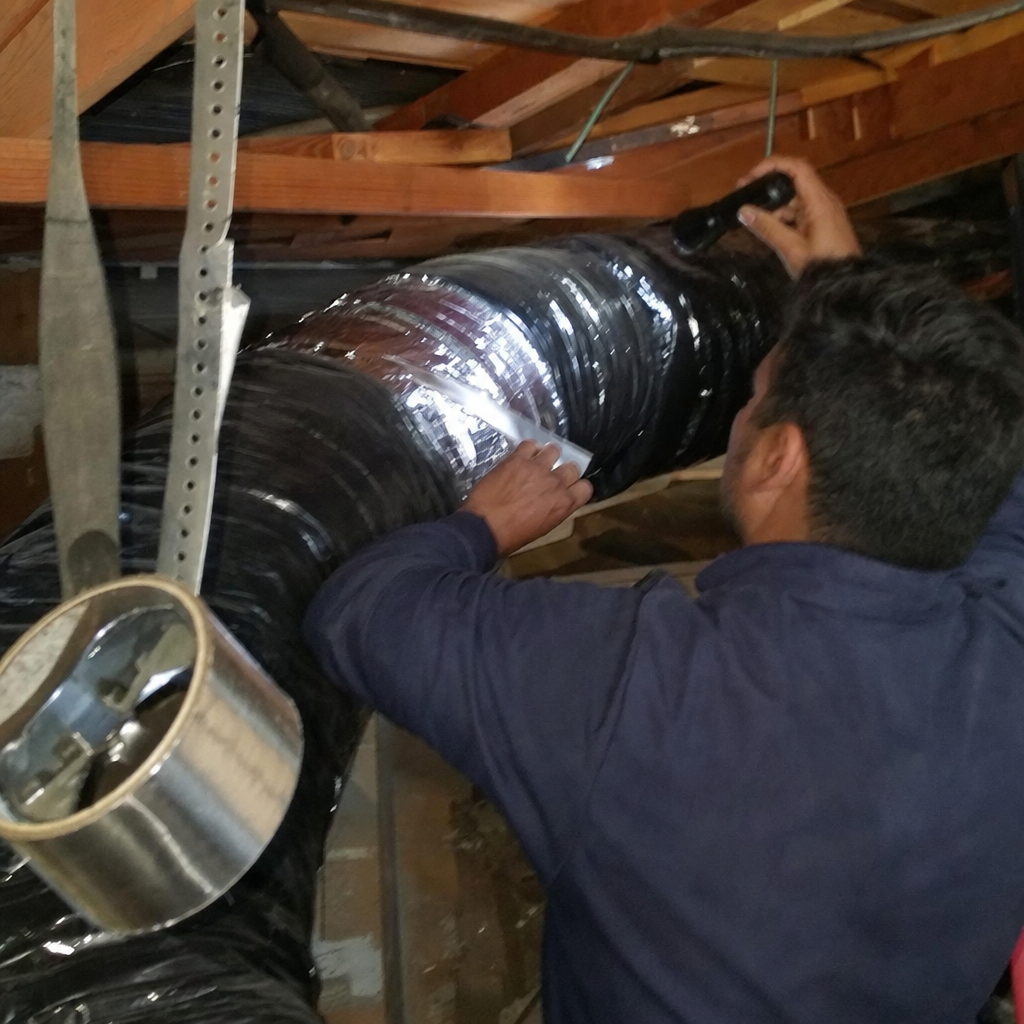
Conditioned air escaping into wall cavities, soffits, or unconditioned attic space is money leaving your house every time the system runs. In Canoga Park, where central AC operates nearly continuously from June through September, those leaks compound fast. We pressure-test the system, identify the leak locations, and seal them with mastic or metal-backed tape appropriate to the surface — giving you a verified result, not a visual inspection guess.
What happens when you call
- 1
A real person answersNo phone trees — you reach a local pro.
- 2
You get an upfront price rangeHonest numbers before anyone is dispatched.
- 3
A background-checked tech heads outLicensed & insured, dispatched right away.
- 4
You approve before work beginsNothing starts until you say go.
Trusted Brands We Service in Canoga Park
We work with Honeywell and Aprilaire air quality products — including filtration and ventilation components that integrate directly with your duct system — and we use Guardsman products for sanitizing treatments following duct repair. Our diagnostic and cleaning equipment includes Rotobrush and Nikro mechanical systems, and Abatement Technologies units for air quality remediation when combustion particulate is involved. For Canoga Park jobs that require specific hardware — flex duct fittings, collar connectors, mastic compounds — we source parts ahead of the visit so the job isn’t waiting on a supply run.
Common Duct Repair & Sealing Problems We See in Canoga Park Homes
- Chalk-brittle original mastic seals on mid-century trunk lines. Homes built during the 1950s–1960s Valley boom — which make up the majority of residential stock in ZIP codes 91303 and 91304 — have original mastic seals that have been cycled through roughly 60–70 Valley summers. Those seals don’t flex anymore; they crack at collar joints, bleed conditioned air into wall cavities, and create entry points for ash and particulate during Santa Ana wind events.
- Inner-liner tears in early flex duct runs. Flex duct installed in the 1970s and 1980s uses an inner liner that degrades under repeated thermal expansion. In Canoga Park’s prolonged cooling season, those liners develop tears that trap wildfire ash residue between the liner and outer jacket — reducing airflow, leaking conditioned air, and creating an odor source that cleaning alone won’t eliminate.
- Compacted combustion particulate at duct joints post-Woolsey Fire. Homes that ran their HVAC systems during the November 2018 Woolsey Fire have ash and combustion particulate packed into joint gaps throughout the duct system. That material acts as an abrasive every subsequent cooling season, accelerating metal fatigue and mastic cracking in a progressive failure pattern that gets worse each year without repair.
- Collapsed or kinked flex duct branches in attic runs. The attic heat in Canoga Park — regularly exceeding 140°F in summer — softens the outer jacket of older flex duct, and sections that aren’t properly supported develop kinks or partial collapses over time. A collapsed branch can reduce airflow to a room by 40–60%, and many homeowners have lived with an underperforming back bedroom for years without connecting it to the ductwork.
Pricing for Duct Repair & Sealing in Canoga Park, CA
Here are honest market ranges for Canoga Park jobs based on what we actually see in these homes:
- Mastic sealant application (full trunk line): $300–$650 depending on system size and number of collar joints requiring treatment
- Flex duct section replacement (per run): $150–$350 per branch, including fittings and mastic sealing at connections
- Metal duct repair (patch or section replacement): $200–$500 depending on access and scope
- Duct insulation replacement (attic runs): $400–$900 for a typical Canoga Park home with exposed attic duct runs
- Full duct repair and sealing package (common in post-Woolsey-Fire homes with multiple failure points): $700–$1,400
What drives cost up on Canoga Park jobs specifically is system age and ash accumulation — joints that need to be cleared of embedded particulate before sealing require more labor than a standard mastic recoat. Scott will give you a clear, itemized estimate before any work starts. Call (424) 365-8367 — estimates are free.
We Also Serve Cities Near Canoga Park
Beyond Canoga Park, we regularly serve homeowners in West Hills, Woodland Hills, Chatsworth, and Northridge — all of which share similar mid-century housing stock, Valley heat exposure, and in many cases the same wildfire smoke infiltration history from the Santa Susana and Chatsworth hills. If you’re in any of these neighboring communities, the same diagnostic approach and repair standards apply.
Serving Canoga Park, CA — Our Local Coverage Area
We’re based in the Canoga Park area and know this community well. Use the map below to see our service coverage — if you’re nearby, we can almost certainly help.
FAQs — Duct Repair & Sealing in Canoga Park
If your system was running during the Woolsey Fire, you very likely need duct repairs in addition to cleaning — cleaning alone won’t fix the structural damage. Here’s why: the combustion particulate from that fire is chemically abrasive, and once it packs into collar joints on aging mastic seals, it accelerates cracking and joint separation every subsequent season the system runs. Cleaning removes loose debris from duct surfaces, but it doesn’t reseal joints that have already cracked open or replace flex liner sections that have been compromised. Homes in the 91303 and 91304 ZIP codes near the Santa Susana Pass corridor are the highest-priority cases. Call us at (424) 365-8367 and we’ll do a diagnostic inspection — at that point you’ll have a clear picture of what the ductwork actually needs.
Two factors stack on top of each other in Canoga Park in a way that’s genuinely different from flatland LA neighborhoods. First, the extreme Valley heat — 100–110°F summers with a cooling season that runs nearly four continuous months — cycles aging mastic seals through more thermal stress per year than homes in coastal communities just 15 miles away. Second, Santa Ana wind events push wildfire smoke and chaparral ash through the Santa Susana Pass directly into this neighborhood’s air intake zones, embedding abrasive particulate at the same collar joints that are already being stressed by heat cycling. Neither factor alone would be as destructive. Together, they explain why original 1950s–1960s mastic seals in 91303 homes fail at rates we don’t see in, say, Sherman Oaks or Studio City.
The symptoms often overlap, but there are patterns. Flex duct failure typically shows up as reduced airflow to a specific room or branch — one bedroom running warm while the rest of the house is fine, or a vent that barely pushes air on a 105°F afternoon. Metal trunk line seal failure is more diffuse: you’ll lose conditioned air across multiple rooms, and you may notice the system running longer to hit setpoint. A persistent smoky or musty odor when the AC first kicks on is often a trunk line issue, specifically ash residue off-gassing from cracked collar joints on the main runs. We pressure-test both during a diagnostic visit, which is the only reliable way to confirm which system is failing and where. Call (424) 365-8367 to schedule that inspection.
Yes — if the source of the odor is ash residue embedded at cracked collar joints, resealing those joints with fresh mastic eliminates the off-gassing pathway. That smell returning each summer when the AC starts up is one of the clearest field indicators we see of Woolsey Fire infiltration at joint-level failures in the metal trunk line. The process is: clear the joint of embedded particulate, apply mastic sealant to create an airtight seal, and optionally follow with a Guardsman sanitizing treatment if the odor has been persistent for multiple seasons. Homes along Victory Boulevard and the Reseda Boulevard corridor in the 91303 ZIP code are exactly the type of mid-century slab homes where we see this pattern most consistently.
Duct insulation matters significantly in Canoga Park’s climate — arguably more than in cold climates. Attic spaces in Canoga Park regularly hit 140–160°F during July and August, and duct runs passing through an uninsulated or poorly insulated attic absorb that heat before delivering air to the living space. The result is that your 72°F setpoint is being fought by heat gain inside the duct system itself, which means longer run times, more debris accumulation, and higher electricity bills across a four-month cooling season. We replace deteriorated duct wrap with properly rated insulation during the same visit as mastic sealing and flex duct repair — it’s one sequence, not a separate project. Call (424) 365-8367 for a free estimate that covers the full scope of what your system actually needs.
Get a Free Duct Repair Estimate for Your Canoga Park Home
If your Canoga Park home is showing any of the signs described on this page — reduced airflow, a smoky or dusty odor when the AC starts, an aging system that’s never been resealed, or a history of running the HVAC through wildfire events — Scott Hill will come out, inspect the system, and give you a straight answer about what it needs. No upsell pressure, no vague estimates. Call (424) 365-8367 to schedule your free diagnostic inspection. We serve all of Canoga Park, including homes in the 91303, 91304, and 91305 ZIP codes, from the Victory Boulevard corridor up through the hillside-adjacent tracts near Santa Susana Pass Road.
Reviewed by Scott Hill, Owner and Lead Technician at Premier Air Duct Solutions Woodland Hills, serving Canoga Park since 2019.


