Air Quality & Sanitizing in Topanga, CA
If you live in Topanga, your air quality concerns aren’t the same as a homeowner in the flatlands. Canyon geography, recurring wildfire smoke, and aging ductwork in converted 1950s and 1960s structures create a contamination profile that standard cleaning schedules simply aren’t built to handle. Scott Hill and the Air Quality & Sanitizing team at Premier Air Duct Solutions Woodland Hills serve Air Quality & Sanitizing in Topanga with professional-grade equipment and a direct understanding of what’s actually inside your ducts. Call us at (424) 365-8367 — estimates are free.
Why Premier Air Duct Solutions Woodland Hills Is Topanga’s Preferred Air Quality & Sanitizing Company
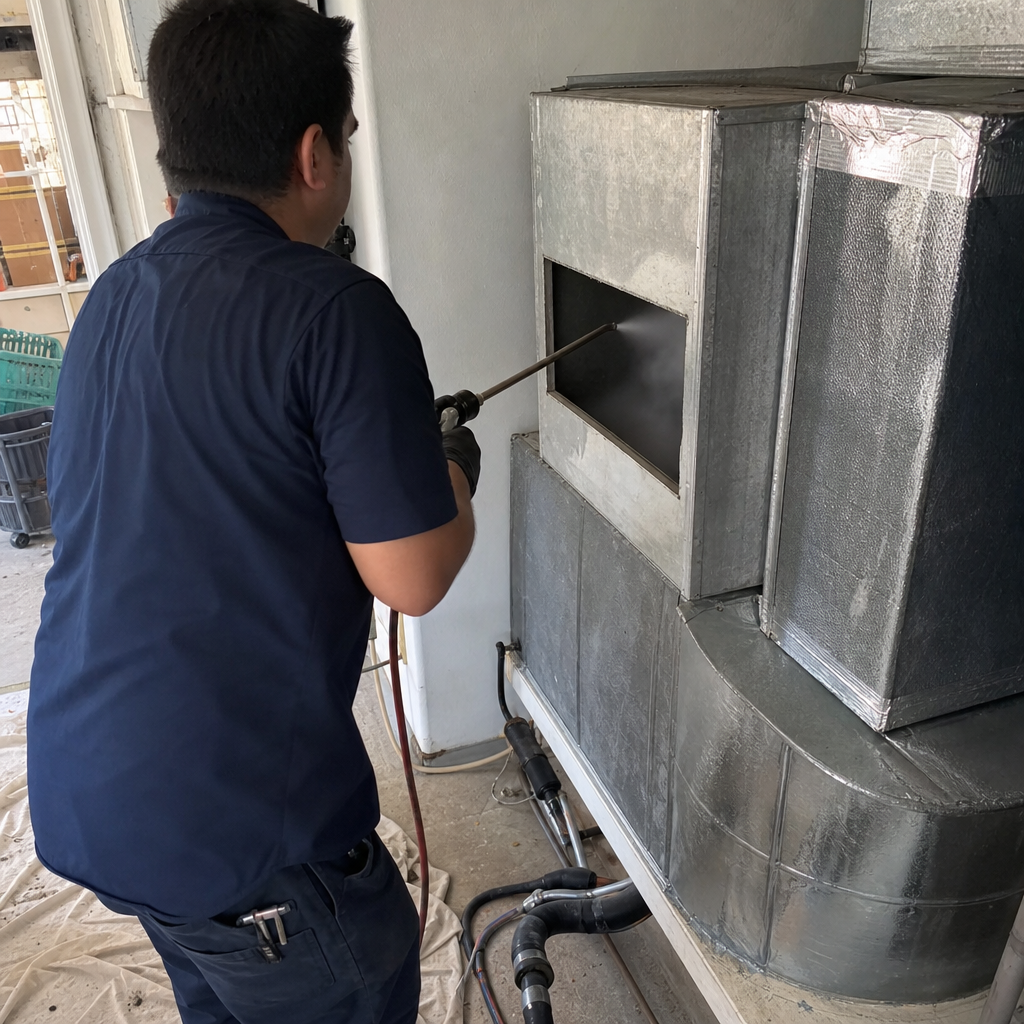
Scott Hill doesn’t dispatch a subcontractor crew to Topanga — he’s the technician on-site, running the equipment, making the call on what your ductwork actually needs. That direct accountability matters in a community like Topanga, where homes are older, duct configurations are non-standard, and the contamination from wildfire events is categorically different from ordinary household dust. You know exactly who showed up and who stands behind the work.
Our reputation across the canyon communities is built on 829 verified five-star reviews — one of the highest review volumes in the air duct cleaning category for the entire West San Fernando Valley corridor, including the Topanga 90290 zip code. Customers in Topanga consistently cite the same thing: Scott explains what he found, shows you the before-and-after, and doesn’t upsell services you don’t need. That’s a harder thing to fake at scale than it sounds.
From our Woodland Hills base, we reach Topanga Canyon quickly. Whether you’re on Old Topanga Canyon Road near the state park entrance, down in the valley-side neighborhoods off Topanga Canyon Boulevard, or up closer to the Fernwood area, we’re familiar with the route and the typical conditions we’ll find once we open your register boots.
Our Air Quality & Sanitizing Services in Topanga
Mold Treatment in Topanga
Topanga’s canyon geography traps humidity during cooler months, and that moisture doesn’t stay on the surface — it works its way into duct joints that were loosely sealed to begin with, then combines with embedded ash residue from fire seasons past to create conditions where mold colonizes fast. A typical mold treatment in Topanga runs $280–$520 depending on duct length and contamination severity. We use Abatement Technologies antimicrobial fogging systems — the same equipment deployed by commercial IAQ specialists — not consumer-grade aerosol treatments. The process addresses biological load at the source, not just the registers you can see.
Bacteria Sanitizing in Topanga
Beyond mold, organic material carried in on wildfire smoke — char particulates, combustion byproducts, biological debris from the chaparral — settles into duct liners and becomes a growth medium for bacteria over time. Bacteria sanitizing in Topanga typically runs $180–$380, and it’s most effective when performed after mechanical extraction rather than as a standalone treatment applied over an uncleared residue layer. We use Guardsman-compatible sanitizing products applied after our Nikro HEPA-rated vacuum extraction pass, so the antimicrobial agent is actually reaching the liner surface — not sitting on top of a gray-brown ash glaze.
Odor Removal in Topanga
Smoke odor in Topanga homes isn’t a surface problem. When a homeowner runs their HVAC during a nearby chaparral fire to stay cool — a completely understandable response — fine combustion particles are drawn deep into flex ductwork where they bond to the liner material. That’s not a smell that dissipates on its own or responds to standard deodorizer sprays. Odor removal in Topanga runs $220–$420, and it requires mechanical dislodging of the embedded residue layer first, followed by a fogging treatment that neutralizes the carbon-based compounds. Skipping the mechanical step and applying treatment directly leaves carcinogenic combustion byproducts sealed underneath — that’s a false remediation, not a real one.
UV Light Installation in Topanga
A UV light system installed at the air handler is one of the most practical long-term investments for a Topanga home, because it continuously addresses biological growth between service visits — which matters in a high-humidity canyon environment where mold recolonization between annual cleanings is a real pattern. We install Honeywell and Aprilaire UV light systems and size them to your specific air handler and duct configuration. UV light installation in Topanga typically runs $320–$580 including the unit and labor. For older A-frame and cabin structures with flex duct systems, we assess airflow restrictions first to confirm the UV placement will actually be effective.
What happens when you call
- 1
A real person answersNo phone trees — you reach a local pro.
- 2
You get an upfront price rangeHonest numbers before anyone is dispatched.
- 3
A background-checked tech heads outLicensed & insured, dispatched right away.
- 4
You approve before work beginsNothing starts until you say go.
The Topanga Wildfire-Smoke Contamination Cycle — What We Actually Find
This is the piece of information that most generic air quality pages don’t explain, and it’s the reason Topanga homeowners need a different approach than someone calling from Encino or Calabasas.
Topanga sits deep inside a high-fire-severity zone in the Santa Monica Mountains. The Woolsey Fire of 2018 burned to the community’s edge. Santa Ana wind events funnel through the canyon topography, accelerating the transport of combustion byproducts, chaparral pollen, and fine particulates directly into homes. The vast majority of Topanga’s housing stock — older cabins, A-frames, and custom structures built as summer retreats in the 1950s through 1970s and later converted to year-round homes — was never designed to filter canyon air. The flex ductwork in these structures is often undersized, non-standard, and loosely sealed at the joints. Those loose connections act as direct infiltration pathways during fire events.
On a call on Old Topanga Canyon Road, we responded to a homeowner who had run their HVAC continuously during a nearby chaparral fire to keep the interior cool. When we opened the register boots in the main living area, the interior flex ductwork showed a heavy gray-brown ash glaze bonded directly to the liner walls — not loose particulate that a single vacuum pass would address, but embedded smoke residue fused to the material. We deployed Nikro HEPA-rated vacuum extraction to mechanically dislodge the residue layer, followed by an Abatement Technologies antimicrobial fogging treatment to neutralize the carbon and biological load trapped in the aging, poorly sealed duct joints. After sanitizing, we installed an Aprilaire whole-home air purifier at the air handler to provide continuous filtration capacity against the next Santa Ana wind event. That sequenced approach — mechanical extraction first, then antimicrobial treatment, then ongoing filtration — is the only way to actually clear this type of contamination.
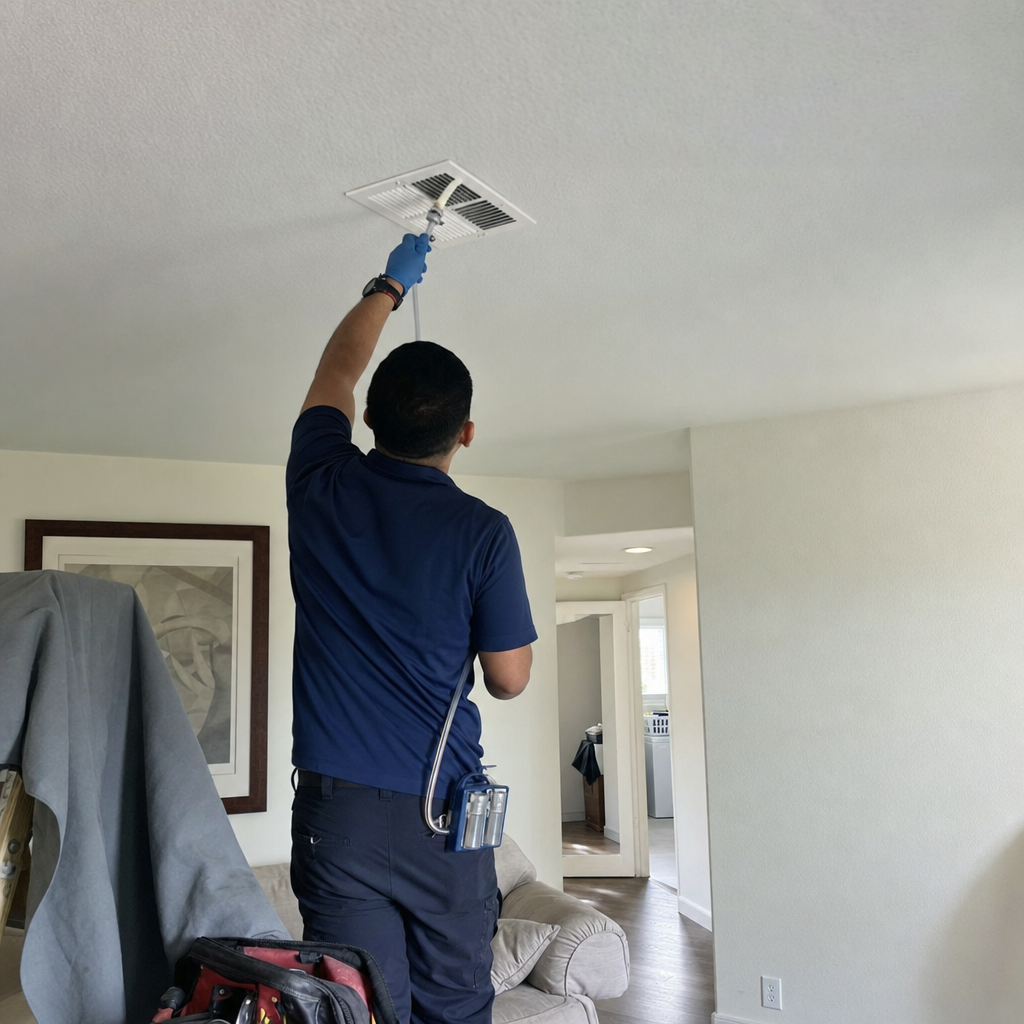
The second stage of the problem is what the canyon’s winter and spring humidity does to ducts that already carry embedded ash residue. Trapped moisture creates condensation inside duct runs. Ash residue is organic material. Organic material plus moisture in a loosely sealed, dark duct cavity equals mold — often visible as a gray-green growth layered directly over the ash coating we described above. This two-stage cycle — smoke infiltration followed by mold colonization of the residue layer — is specific to Topanga’s combination of fire risk and canyon microclimate. It’s why a single-service-per-year cleaning schedule that works fine in Woodland Hills or West Hills isn’t calibrated to what Topanga homes actually face.
Trusted Brands We Service in Topanga
We work with Honeywell, Aprilaire, Guardsman, and Abatement Technologies products on Topanga jobs, and we carry common components for each to minimize turnaround time. Aprilaire whole-home purifiers and Honeywell UV systems are our most frequently installed units in Topanga, specifically because canyon homeowners need continuous filtration capacity between service visits — not just a one-time remediation. Rotobrush and Nikro mechanical systems handle the extraction work. Guardsman antimicrobial products are applied post-extraction. Every product decision is made based on what your specific duct configuration and contamination profile actually calls for.
Common Air Quality & Sanitizing Problems We See in Topanga Homes
- HVAC operation during active nearby wildfires: Running a heating or cooling system during a chaparral fire forces fine ash and char particulates deep into undersized flex ductwork, where they bond to the liner material. A single standard vacuum pass cannot remove bonded combustion residue — mechanical agitation with HEPA extraction is required first.
- Two-stage contamination — ash residue followed by mold: Canyon humidity in cooler months creates condensation inside duct runs that already carry embedded ash residue from fire seasons. This accelerates mold colonization inside the loosely sealed duct connections typical of Topanga’s converted 1950s–1970s structures, producing a layered contamination profile that a single treatment type can’t address.
- False remediation from treatment-over-residue applications: Applying an antimicrobial fogging or sanitizing treatment directly over an uncleared smoke-residue layer seals carcinogenic combustion byproducts underneath the coating rather than neutralizing them. Homeowners often don’t realize the remediation was incomplete until odors return or air quality tests fail.
- Non-standard flex ductwork in converted cabins and A-frames: Many Topanga homes on Topanga Canyon Boulevard and the surrounding canyon roads were retrofitted with flex duct systems that don’t meet current sizing standards, creating restricted airflow, loose joint seals, and limited access for standard cleaning equipment. Scott assesses duct geometry before starting to confirm the right extraction approach for the specific configuration.
Pricing for Air Quality & Sanitizing in Topanga, CA
Here’s a straightforward breakdown of typical ranges for Topanga’s market:
- Mold Treatment: $280–$520
- Bacteria Sanitizing: $180–$380
- Odor Removal: $220–$420
- UV Light Installation: $320–$580
- Air Purifier Installation (Aprilaire / Honeywell whole-home): $420–$750
- Allergen Reduction Treatment: $160–$320
What moves a Topanga job toward the higher end of these ranges: non-standard flex ductwork requiring modified access, heavy smoke-residue contamination requiring multiple extraction passes, and older structures with long or complex duct runs. Combining services in a single visit — mechanical extraction plus sanitizing plus UV installation — is typically more cost-effective than scheduling them separately. Call (424) 365-8367 for a free on-site estimate — we’ll give you a specific number before we start anything.
We Also Serve Cities Near Topanga
In addition to Topanga, we serve homeowners throughout the surrounding communities: Calabasas, Woodland Hills, West Hills, and Encino. If you’re a Topanga resident recommending us to a neighbor in any of these areas, the same owner-operated approach and professional-grade equipment applies across every job, regardless of zip code.
Serving Topanga, CA — Our Local Coverage Area
We’re based in the Topanga area and know this community well. Use the map below to see our service coverage — if you’re nearby, we can almost certainly help.
FAQs — Air Quality & Sanitizing in Topanga
Yes — wildfire smoke residue requires a sequenced mechanical-plus-chemical approach that standard dust cleaning is not designed for. Smoke particulates from chaparral fires bond chemically to flex duct liner material rather than sitting loose the way ordinary dust does. A single vacuum pass won’t dislodge bonded ash residue; it requires mechanical agitation via a system like our Nikro HEPA extraction setup, followed by an Abatement Technologies antimicrobial fogging treatment to address the carbon and biological load underneath. Applying sanitizer over uncleared residue doesn’t remediate — it seals the problem in place. Call (424) 365-8367 to schedule an assessment before the next fire season hits.
In most cases, sanitizing can proceed without full duct replacement, but the condition of the existing flex ductwork determines the approach. Many of Topanga’s 1960s A-frames have flex duct that’s still structurally intact but loosely sealed at the joints — that’s an infiltration problem, not necessarily a replacement scenario. Scott assesses duct integrity on every job before recommending a path forward. If mechanical cleaning and sanitizing are viable, we proceed with those. If duct sections are collapsed or deteriorated in a way that would make sanitizing ineffective or unsafe, we’ll tell you that directly, with specifics. Call (424) 365-8367 for an honest evaluation.
Canyon humidity accelerates mold colonization significantly when ash residue is already present in the ductwork. Ash residue from wildfire smoke events is organic material — it provides a nutrient base. Topanga’s canyon topography traps cooler, moister air in winter and spring months, creating condensation inside duct runs. Mold colonizes the ash layer directly, producing a layered contamination profile: combustion residue on the bottom, biological growth on top. This is why homes in Topanga’s 90290 zip code often need both mechanical extraction and antimicrobial treatment rather than one or the other. The mold treatment cost for this type of scenario typically runs $280–$520. Call (424) 365-8367 if you’ve had smoke infiltration events and noticed musty odors returning seasonally.
A correctly sized and properly installed whole-home air purifier makes a measurable difference for Topanga homeowners dealing with chaparral pollen and fine combustion particulates — but only if it’s matched to your air handler and duct configuration. We install Aprilaire and Honeywell whole-home units that filter at the air handler level, meaning every cubic foot of air your system circulates passes through filtration continuously. For a Topanga home with older flex ductwork and restricted airflow, unit sizing matters: an oversized unit on a restricted system reduces effectiveness. Scott sizes every installation to the actual airflow conditions of your specific home. Installation runs $420–$750 for whole-home units. Call (424) 365-8367 for a free estimate.
Topanga homeowners should plan for sanitizing every 12–18 months rather than the standard 2–3 year interval common in lower-risk areas — and immediately following any nearby wildfire event where the HVAC system was running. The combination of seasonal chaparral pollen, fire-season smoke infiltration, and canyon humidity means contamination accumulates faster in Topanga’s duct systems than in flatland cities like Woodland Hills or Encino. If your home is a converted 1950s or 1960s structure with non-standard flex ductwork, the loosely sealed joints compound the infiltration rate. After a significant smoke event, don’t wait for the annual cycle — call (424) 365-8367 and we’ll assess whether the ductwork needs immediate attention.
Reviewed by Scott Hill, Owner and Lead Technician at Premier Air Duct Solutions Woodland Hills, serving Topanga since 2019.


